


- Lara Sharrock
- Director of Sustainability
- Sustainability
- 14 September 2026
- 5 min
Share



If you're anything like me, the ‘back to school’ September feeling is a call to brush up on reporting regulations before we head into the next cycle of year-end reports.
One standard that piqued my interest over the summer is the European Sustainability Reporting Standard-40a (ESRS-40a), of which EFRAG published the exposure draft on 23rd July. It’s a reporting standard for companies headquartered outside the EU but with significant operations inside it, designed so that non-EU multinationals with a large EU footprint face comparable scrutiny to their EU-based peers.
The draft ESRS-40a broadly mirrors the structure of the simplified ESRS, keeping the same twelve standards and reporting areas, but is a smaller exercise with some distinct differences. It’s based on impact materiality rather than double materiality – meaning no need for risk, opportunity or dependency disclosures. No EU Taxonomy disclosures are required either. And there are phased transitional provisions for first-time reporters.
The consultation on the new standards is currently open, with first reports set to cover FY28 (so reporting in 2029). That might sound comfortably far away, but the decisions that shape those reports are ones you should be making now.
So, as you set sights on your next reporting cycle, here are the four things you should be thinking about:
1. Confirm group-level scope
ESRS-40a follows EU revenue, wherever the parent sits – meaning even if your priority is to prepare for IFRS S1/S2, you’ll still need to check whether you’ll be in scope for this.
There isn’t an employee threshold for 40a; instead, two tests determine whether you’re in scope, and both have to be met simultaneously:
1. You’re a non-EU parent group with more than €450 million EU net turnover in each of the last two consecutive financial years, and
2. You have an EU subsidiary or branch that generated more than €200 million net turnover in the preceding financial year
2. Pay attention to entity-level reporting (which comes first)
If your non-EU group is in scope for ESRS-40a, then there’s a good chance that one or more of your subsidiaries will additionally be captured by ESRS’ ‘Wave 2’ company obligations (the threshold for this is €450 million+ net turnover and more than 1,000 employees in an EU country). This entity will have to report sooner than your group – as soon as FY27 (so, 2028 reports) – and will need to produce a full ESRS report (i.e: not the ESRS-40a). Your group obligation under 40a starts a year later.
If this applies to you, then there are a couple of different approaches you could take to your reporting:
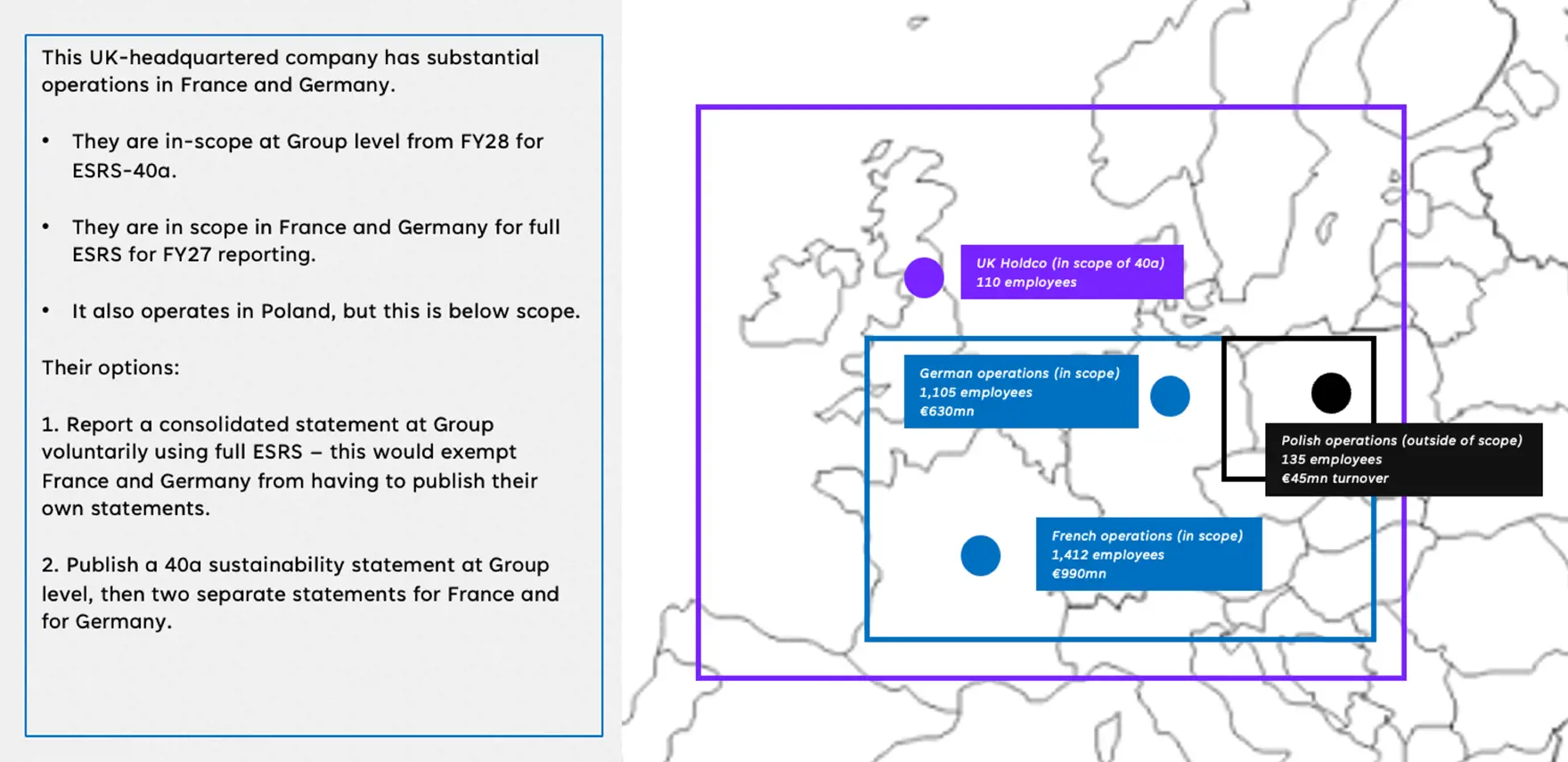
Either: publish a 40a sustainability statement at Group level, then separate full ESRS statements for your Wave 2 entities
Or: publish a consolidated statement at Group level voluntarily using full ESRS – this would exempt all Wave 2 entities from having to publish their own statements.
Let’s imagine a scenario where a UK-headquartered company has substantial operations in France and Germany, such that:
They are in-scope at Group level from FY28 for ESRS-40a
They are in scope in France and Germany for full ESRS for FY27 reporting
It also operates in Poland, but this is below scope
Here’s how the two options could play out in practice:
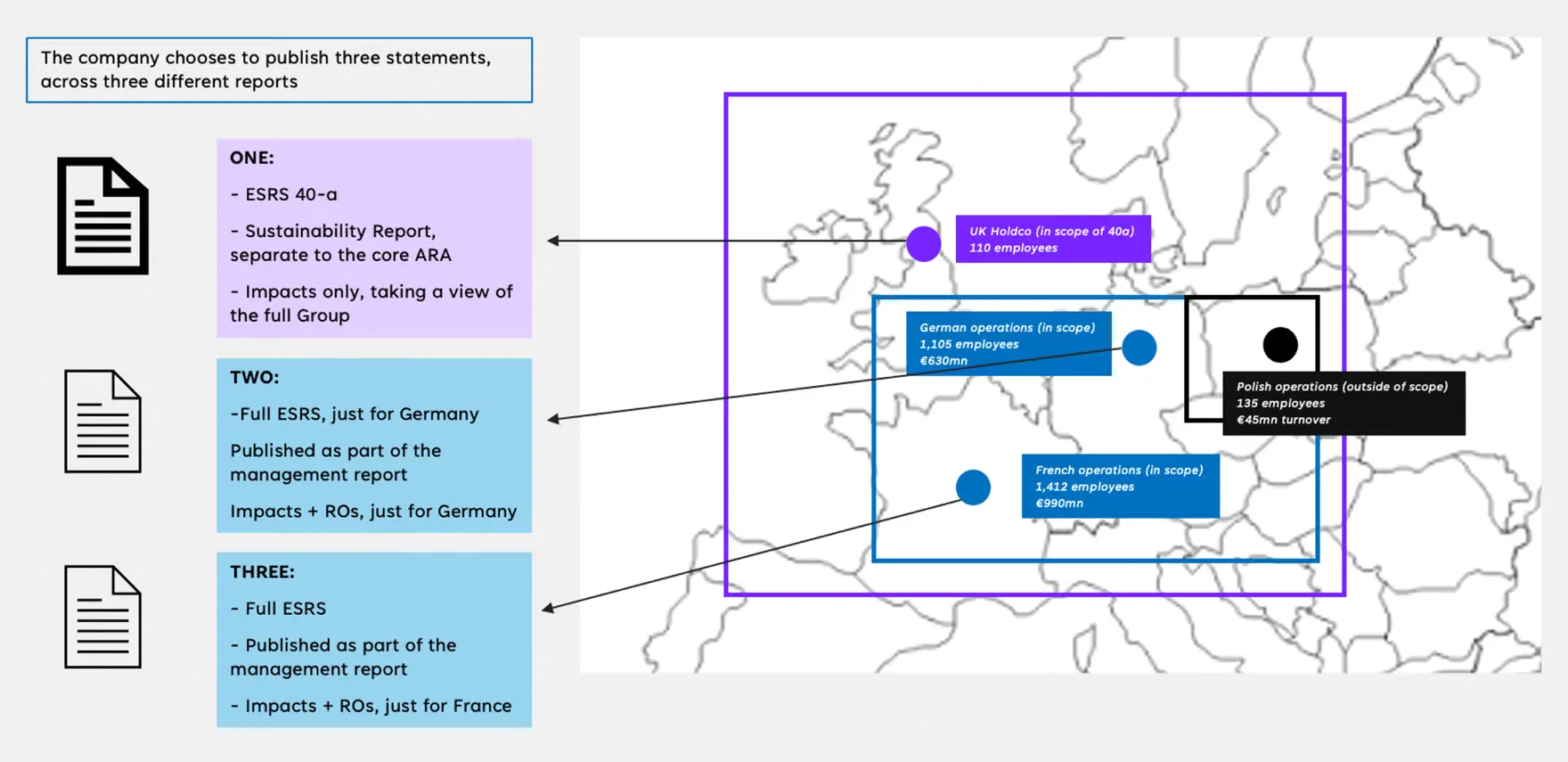
The right approach ultimately depends on your group’s structure, objectives, and approach to assurance, but it’s worth noting that opting for the full ESRS approach would unlock subsidiary exemptions and would guard against the complexity of running multiple disclosure systems.
3. If pursuing ESRS-40a, consider your reporting approach (and be wary of the mixed route)
If reporting against ESRS-40a is the right approach for your company, then the next step will be to decide on how you’ll report against this.
The ESRS-40a offers three options for reporting:
Global approach ESRS-40a: Material impacts are reported at the global level for all topics (note: this is limited to impact materiality only)
Mixed approach ESRS-40a: Climate impacts are reported at the global level, while other topics are reported at an EU level
Full ESRS: Scrap 40a altogether and voluntarily report against full ESRS at a group level (as mentioned in the previous section). This comes with the benefit of a subsidiary exemption (though note, as this route is full ESRS, it requires double materiality, not impact-only)
The mixed approach is somewhat unintuitive as it would allow what’s meant to be a group-level report to only cover EU-related impacts. This doesn’t sit well with the nature of global impacts such as human rights abuses or deforestation. As a result, EFRAG wants companies to be sure that if they do take the mixed route, they can confidently isolate those impacts geographically to just the EU – so for instance, if a company sells palm oil harvested in Indonesia in the EU, it would likely struggle to use the mixed approach for this impact because it couldn’t argue that the impact was isolable to the EU. EFRAG notes that concerns have been raised by members about the approach – especially questioning relevance, comparability, level-playing field, and implementation and audit challenges. There’s a good chance it won’t survive the consultation in its current form.
Realistically, you’re probably safest planning for global impacts, while keeping an eye on what comes out of EFRAG’s consultation.
4. Plan for interoperability with other frameworks
EFRAG’s exposure draft outlines key areas of interoperability between ESRS-40a and IFRS S1/S2. There are key areas of convergence across governance, risk management and targets within general disclosure requirements, and in transition planning, carbon credits, GHG emissions and emission reduction targets within climate disclosures.
To avoid double reporting, groups can either incorporate disclosures by reference (from mandatory reports published before or at the same time, with information clearly identified in the source document) or produce a single report satisfying both the ESRS-40a and the jurisdictional standards (this single report may, for example, have separate chapters for common information and additions, and use either the ESRS-40a or the jurisdictional report as a starting point).
One of the frustrating areas of divergence between IFRS, ESRS, and ESRS-40a is in their approach to materiality (they ask for financial, double, and impact materiality respectively). If you’re in scope for IFRS S1/S2 within your jurisdiction, as well as ESRS or ESRS-40a, then your best bet will be to undertake a double materiality assessment to satisfy all frameworks.
Oh, and one last thing: The consultation runs until 31st October. Responding to it is the cheapest influence you will ever have over a standard you may spend years reporting against.
For any questions or support with ESRS-40a, full ESRS, or IFRS S1/S2 reporting, please reach out to our sustainability team, by contacting [email protected].