

- Lara Sharrock
- Director of Sustainability
- Opinion
- Sustainability
- Events
- 04 February 2026
- 4 min
Share


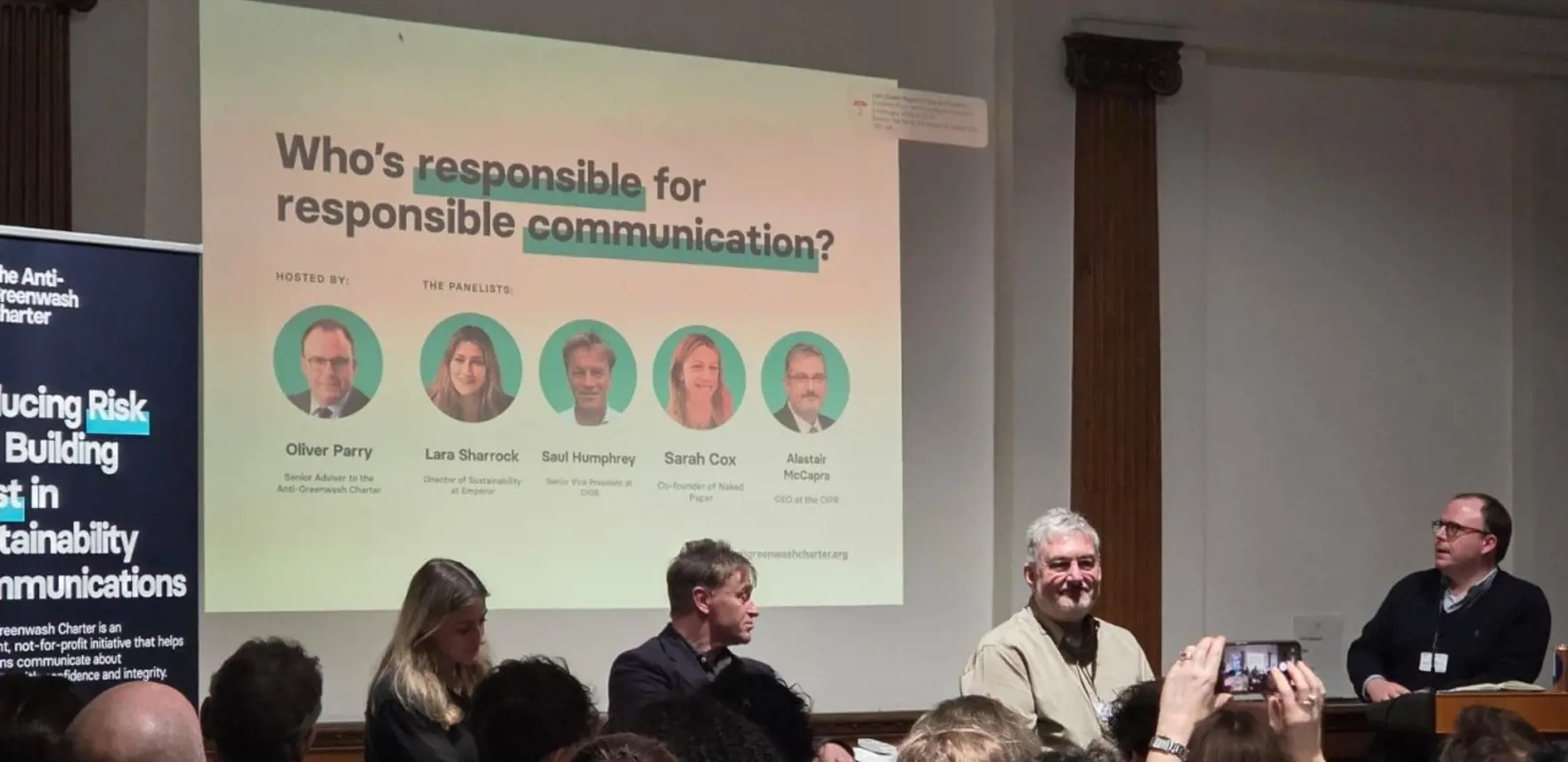
This week, I had the privilege of speaking at The Anti-Greenwash Charter’s inaugural event - The Future of Responsible Communication – exploring the question: ‘Who's responsible for responsible communications?’
Three recent news stories provide a particularly pointed framing for the discussion:
The CMA’s warning last week that companies are fully responsible for green claims - even where misleading claims stem from unreliable supplier data
Bloomberg Law research suggesting that investors increasingly care only about the G in ESG
Nestlé’s CEO citing Trump-era politics as a driver of the company’s recent greenhushing
Taken together, it paints a bleak picture. If investors no longer care, if companies are rolling back or staying quiet to appease geopolitics, and if scrutiny on the few who do speak out is only tightening… then why bother?
Thankfully, the panel discussion gave greater cause for optimism. Here’s what I’m taking away:
Companies are still taking action on sustainability. PwC’s State of Decarbonization report last year showed that 84% of companies are standing by their climate commitments. Earlier this month, CDP reported a huge surge in the number of companies scoring an ‘A’.
What’s changed is where and how sustainability shows up. Climate is increasingly discussed in the context of business resilience, capex, and long-term strategy. Social issues surface through workforce risk and supply chains. Governance is the mechanism through which all of that is assessed and enforced.
We’ve talked for years about sustainability becoming embedded in corporate strategy. Perhaps dwindling investor interest in the ‘E’ and ‘S’ is the reckoning that finally forces that integration to happen.
Boards face the age-old struggle: short-termism vs long-termism. As leaders grapple with the impact that AI will have on their businesses, it’s unsurprising that sustainability has slipped down the agenda.
Reassuringly, research from the Climate Governance Initiative last year showed 84% of directors globally see climate as a mid-to-high priority - rising to 94% in the UK. Transition planning presents an opportunity for innovation and is key to long-term business viability.
Regulation, of course, plays a critical role in maintaining board focus, so there’s an undeniable risk amid deregulation and governments prioritising growth. The smaller the business, the faster sustainability may fall off the agenda; last year we saw a marked decline in the number of AIM companies publishing Sustainability Reports, from 24% in 2024 to 15% in 2025.
For now, though, most large listed businesses in the UK seem to be staying the course, and we haven’t seen widespread board pushback. Doing good business still makes good business sense.
There’s a welcome shift in tone. Patagonia described its sustainability efforts as a “work in progress” in its most recent Sustainability Report. Others have acknowledged that moonshot targets are proving unattainable.
Heineken’s admission that it is on an “imperfect journey to a better world”, as it reworked its social sustainability strategy, could be read as a lowering of ambition. I see it instead as a smart refocus on what is genuinely material - and where impact can realistically be delivered.
This kind of honesty isn’t weakness. We’re in an era where trust is fragile, information is abundant, and AI is accelerating the spread of confident-sounding misinformation at scale. Big, bold, unsubstantiated claims no longer fly; incremental progress - “from X to Y by Z” - cuts through.
A recurring theme in our discussion was uncertainty around what “good” looks like. When the IFRS announced the development of its International Sustainability Standards Board (ISSB) back in 2021, it felt like the golden ticket reporters (and readers) had been waiting for: a drive for consistency and comparability. Since then, progress has been uneven - advances in some jurisdictions countered by dilution and delays in others.
There does appear to be light at the end of the tunnel for UK reporters, with clarity on the UK Sustainability Reporting Standards expected next month.
Beyond reporting, the carrot to the ASA’s stick is noticeably absent. The Green Claims Code is helpful for corporates, but for consumers the world of green claims remains a minefield. That said, there are exciting developments on the horizon: The Anti-Greenwash Charter's truMRK is worth a look if you haven’t come across it yet.
Getting sustainability comms right is a shared responsibility. Boards that see the value in sustainability must do more to set the tone from the top. Sustainability, finance, IR, brand and comms teams need to work together to ensure claims are credible, understandable and evidence-based.
I’d like to believe greenwashing is rarely deliberate. More often, it’s the product of weak internal governance: unclear ownership, inconsistent approval processes, and messages drifting or lacking substantiation as they move across channels.
Returning to the three news stories I raised at the start, I hope you’ll join me in feeling quietly optimistic.
More scrutiny, at a time already defined by low trust, raises the bar for sustainability communications: they must be specific, evidence-based and defensible. Declining investor focus on the E and S - alongside continued pressure around the G - means sustainability must be embedded within business strategy, with boards taking clear responsibility.
If the net result is an era of quiet progress, that's okay. It's better to say less, but say it better, and focus on building the systems, governance and evidence to back up what you're saying.
A huge thanks to Charlie Martin and The Anti-Greenwash Charter team for what felt like a real success this week. Somewhere between the over-rehearsal of panels and the pre-planting of audience questions, events can be a little stale. This one felt different. There was a genuine buzz in the room; hands shot up when we opened the Q&A, and the conversation felt real.
Please get in touch with [email protected] if you'd like to discuss any of the above or hear more about how Emperor can help you on your Sustainability journey.